
What pays for
the next frontier?
The business is growing fast. Sigma remains skeptical that its cash returns can justify the price of the next frontier.
The working thesis.
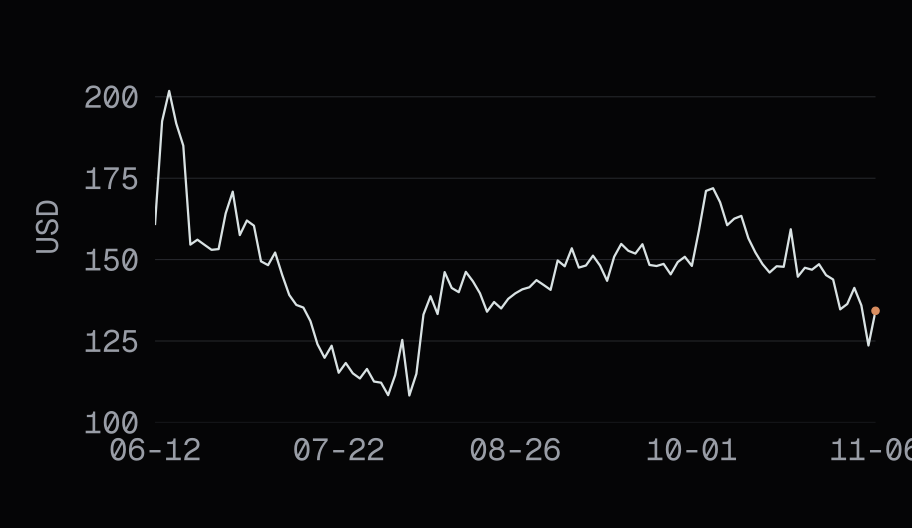
Sigma remains bearish on SpaceX at the November 6 close of $134.27. Revenue is accelerating, but the expansion still demands far more cash than operations generate. The equity valuation leaves little room for a slower or more expensive path to durable cash returns.
The price of the promise.
Nasdaq · SPCX · Daily closing price · USD · Jun 12, 2026–Nov 6, 2026
Download chart (SVG)Download prices (CSV)
View closing-price data
| Date | Close (USD) |
|---|---|
| 2026-06-12 | $160.95 |
| 2026-06-15 | $192.50 |
| 2026-06-16 | $201.80 |
| 2026-06-17 | $191.82 |
| 2026-06-18 | $185.00 |
| 2026-06-22 | $154.60 |
| 2026-06-23 | $156.11 |
| 2026-06-24 | $154.54 |
| 2026-06-25 | $153.00 |
| 2026-06-26 | $153.23 |
| 2026-06-29 | $164.19 |
| 2026-06-30 | $170.86 |
| 2026-07-01 | $157.54 |
| 2026-07-02 | $162.00 |
| 2026-07-06 | $160.42 |
| 2026-07-07 | $149.47 |
| 2026-07-08 | $148.30 |
| 2026-07-09 | $152.16 |
| 2026-07-10 | $145.30 |
| 2026-07-13 | $139.14 |
| 2026-07-14 | $136.08 |
| 2026-07-15 | $135.27 |
| 2026-07-16 | $131.11 |
| 2026-07-17 | $123.99 |
| 2026-07-20 | $119.85 |
| 2026-07-21 | $123.54 |
| 2026-07-22 | $115.26 |
| 2026-07-23 | $118.24 |
| 2026-07-24 | $115.07 |
| 2026-07-27 | $113.50 |
| 2026-07-28 | $116.41 |
| 2026-07-29 | $112.55 |
| 2026-07-30 | $112.20 |
| 2026-07-31 | $108.37 |
| 2026-08-03 | $114.53 |
| 2026-08-04 | $125.33 |
| 2026-08-05 | $108.27 |
| 2026-08-06 | $114.92 |
| 2026-08-07 | $133.11 |
| 2026-08-10 | $138.74 |
| 2026-08-11 | $133.29 |
| 2026-08-12 | $146.15 |
| 2026-08-13 | $141.29 |
| 2026-08-14 | $140.00 |
| 2026-08-17 | $146.23 |
| 2026-08-18 | $143.34 |
| 2026-08-19 | $139.65 |
| 2026-08-20 | $134.00 |
| 2026-08-21 | $136.97 |
| 2026-08-24 | $135.00 |
| 2026-08-25 | $137.95 |
| 2026-08-26 | $139.63 |
| 2026-08-27 | $140.87 |
| 2026-08-28 | $141.50 |
| 2026-08-31 | $143.69 |
| 2026-09-01 | $142.23 |
| 2026-09-02 | $140.71 |
| 2026-09-03 | $149.74 |
| 2026-09-04 | $147.95 |
| 2026-09-08 | $153.47 |
| 2026-09-09 | $147.55 |
| 2026-09-10 | $148.18 |
| 2026-09-11 | $151.21 |
| 2026-09-14 | $148.15 |
| 2026-09-15 | $143.49 |
| 2026-09-16 | $150.88 |
| 2026-09-17 | $154.81 |
| 2026-09-18 | $152.71 |
| 2026-09-21 | $151.85 |
| 2026-09-22 | $154.72 |
| 2026-09-23 | $148.36 |
| 2026-09-24 | $148.03 |
| 2026-09-25 | $148.68 |
| 2026-09-28 | $145.47 |
| 2026-09-29 | $149.24 |
| 2026-09-30 | $150.86 |
| 2026-10-01 | $148.07 |
| 2026-10-02 | $158.96 |
| 2026-10-05 | $171.09 |
| 2026-10-06 | $171.92 |
| 2026-10-07 | $167.60 |
| 2026-10-08 | $160.57 |
| 2026-10-09 | $162.57 |
| 2026-10-12 | $163.42 |
| 2026-10-13 | $156.54 |
| 2026-10-14 | $152.16 |
| 2026-10-15 | $148.62 |
| 2026-10-16 | $146.03 |
| 2026-10-19 | $147.96 |
| 2026-10-20 | $147.79 |
| 2026-10-21 | $159.31 |
| 2026-10-22 | $144.75 |
| 2026-10-23 | $147.49 |
| 2026-10-26 | $146.90 |
| 2026-10-27 | $148.58 |
| 2026-10-28 | $145.23 |
| 2026-10-29 | $143.89 |
| 2026-10-30 | $134.72 |
| 2026-11-02 | $136.37 |
| 2026-11-03 | $141.31 |
| 2026-11-04 | $135.92 |
| 2026-11-05 | $123.62 |
| 2026-11-06 | $134.27 |
SpaceX can be an extraordinary company and still be an unforgiving investment. Sigma’s concern is the price of its ambitions: how much capital they absorb, and how much cash eventually reaches shareholders.
Reported figures are unaudited. Basic equity value is Sigma’s illustrative calculation using different observation dates, not fully diluted enterprise value. Calculations and qualifications appear in the analysis below.
Follow the cash, not just the growth

The September 2026 Form 10-Q reports $13.097 billion of operating cash inflow against $48.069 billion of property, plant and equipment purchases for the first nine months. That is a $34.972 billion shortfall on this simple comparison, before rebates, capitalized interest and other investing flows. These unaudited figures are not a company-defined free-cash-flow measure.[2]
Our interpretation is straightforward: the existing cash engine has not yet caught up with the infrastructure build. Growth spending can create valuable capacity. But shareholders still need that capacity to produce an adequate return, rather than require another round of equally expensive expansion.
The filing also records $85.675 billion of net IPO proceeds. That provides substantial funding; the spending gap alone does not establish financial distress. Sigma’s objection concerns the eventual return on that capital, not a claim that the company is about to run out of money.[2]
Give the growth case its due
The third-quarter release reports $14.575 billion of revenue: $1.767 billion from Space, $5.248 billion from Connectivity and $7.560 billion from Super Intelligence. Connectivity generated $2.367 billion of operating income. These unaudited company-reported results give the bullish case real substance; this is not simply a business selling a distant promise.[1]
The potential advantage is integration. Launch capability, satellite distribution and computing infrastructure could reinforce each other. If shared capabilities lower delivery costs and improve utilization, that could support more profitable growth. Sigma treats that benefit as something to establish in the economics, rather than assume from the corporate structure.
The bearish view would weaken if this growth increasingly funded itself. A quarter of strong operating performance deserves attention. It still cannot, on its own, establish what shareholders will receive after the continuing cost of servers, satellites and launch infrastructure.

A remarkable business still has to earn the price paid for it.
The price already asks for a great deal
Nasdaq records a $134.27 close on November 6. Applying that price to the October 15 Class A and B share counts implies approximately $1.82 trillion of basic equity value, or 31.3 times quarterly revenue annualized. This illustrative calculation is not fully diluted enterprise value; it ignores later share changes, and the revenue annualization is not a forecast.[3][2][1]
That arithmetic is why Sigma remains skeptical even after the share-price retreat. The valuation requires more than a large addressable market. It needs a long period of growth, attractive incremental returns and cash that remains after the infrastructure is maintained and expanded.
For an investor, the risk is that the company succeeds operationally while the shares deliver less than expected. A business can grow into a much larger version of itself and still fall short of the outcome embedded in its starting price. Sigma is not assigning a price target or forecasting the next trading move.
Where the argument can be wrong
Sigma’s skepticism could underestimate operating leverage. New capacity often costs money before it earns revenue; utilization can improve sharply once that capacity fills. If the existing build supports much more revenue without proportionate new spending, the current cash gap may overstate the long-term funding burden.
Consolidated numbers can also conceal very different economics. A mature connectivity business and an expanding compute business do not have the same investment cycle. Sigma would want a consistent account of their separate cash generation and reinvestment needs before treating either the strongest or weakest segment as representative of the whole.
What would change Sigma’s view
Sigma would become more constructive after several reporting periods of improving operating cash conversion, clearer disclosure of maintenance versus growth capital, and evidence that newly deployed capacity earns attractive returns. A lower equity price could also offer more room for disappointing execution.
Our view would become more cautious if spending continued to outrun cash generation without better utilization, or if dilution and changing segment definitions made shareholder returns harder to assess. These are observable tests for the thesis, not a promise that the share price will move on a particular schedule.

Bearish, until the cash catches up.
At the November 6 close of $134.27, Sigma would avoid initiating a long position in SpaceX. Our bearish view rests on the combination of a demanding valuation and infrastructure spending that still exceeds operating cash generation. Growth alone does not establish an adequate shareholder return. Sustained improvement in cash conversion, clearer returns on new capacity, or a materially lower price could change that conclusion.
Sources & disclosure
Primary documents checked on 2026-11-08. Reported figures, company claims, and Sigma’s interpretation retain their separate roles.
- SpaceX · Third-quarter 2026 earnings release ↗Third-quarter 2026 financial highlights; revenue and operating income by segment; unaudited. Accessed 2026-11-08.
- SpaceX · Form 10-Q, September 30, 2026 ↗Cover-page share counts at October 15, 2026; consolidated cash flows for the nine months ended September 30, 2026; amounts in millions unless stated otherwise. Accessed 2026-11-08.
- Nasdaq · SPCX daily historical prices ↗103 daily unadjusted closes, June 12 through November 6, 2026; checked against the Nasdaq historical API. Accessed 2026-11-08.